
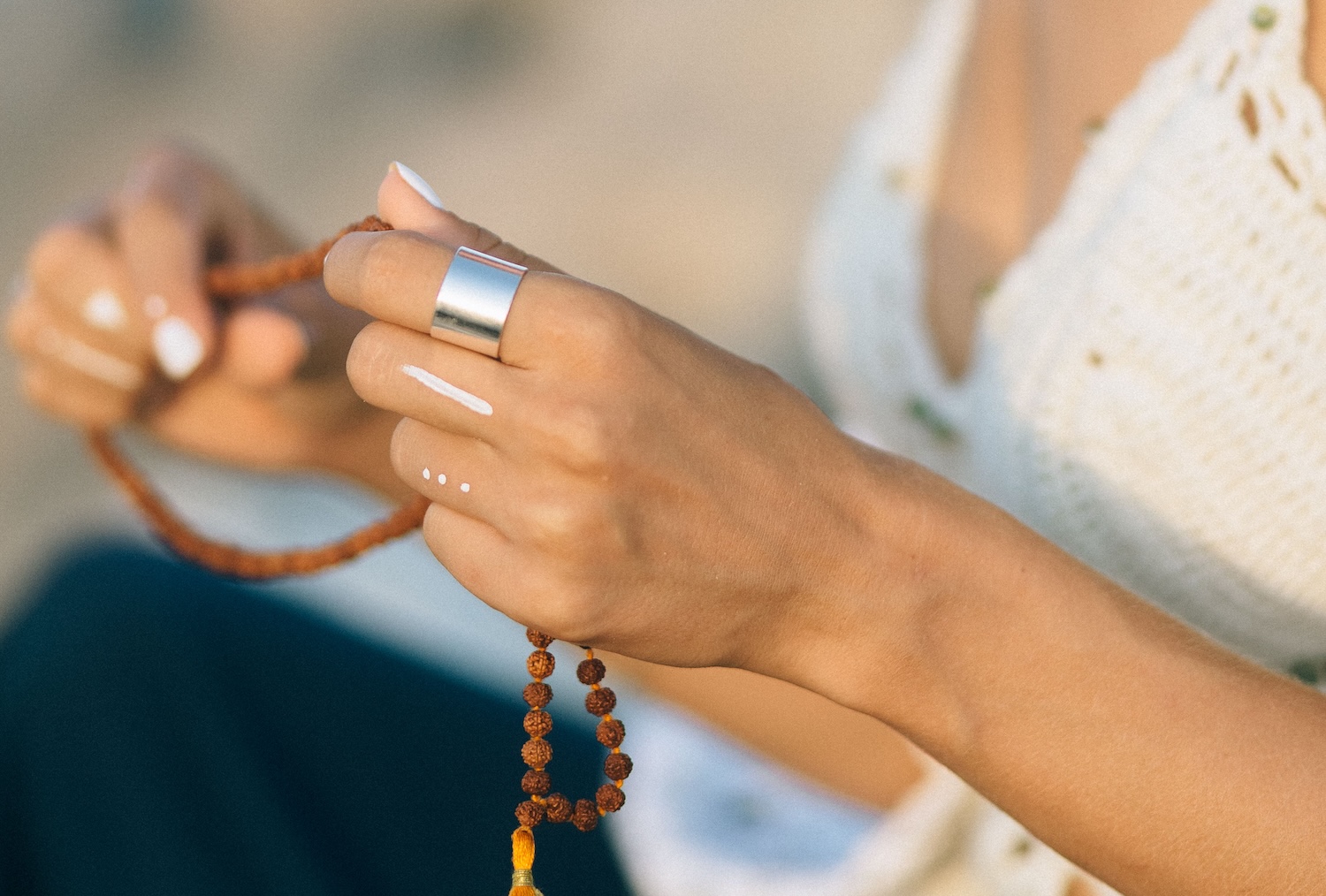
How to Use Your Mala with Sitting Meditation
Introduction
(00:10)
Greetings, dear friends. This is Dawn Boiani Sandberg, and I am the owner of BuddhistMala.com at Sakura Designs. And we are currently in our 21st year of doing business. And I wanted to thank all of our supporters worldwide for a thriving business over the years, even with the competition of some of the Asian imports. I’m really grateful to our customer base that acknowledges that we are making malas here by hand in Boulder, Colorado, and we make everything to order. So it’s nice if someone’s ordering a custom design, I will send a little photograph of it before I send it out. So we offer repair services and TLC and custom heartfelt mala beads made by Dharma practitioners. But in all these 20 years, I realized I had not done a video on how to use your mala. So I thought I’d like to offer a brief video of how beginners can use mala beads along with their sitting meditation.
Setting Up Your Meditation Space
(01:21)
I am an authorized meditation instructor. So I’d like to give sort of just some of the basic two-minute meditation instruction and then how to use your mala that you hopefully get from us. And so basically you want to create an area in the home. If you want to buy a zafu and zabuton, some meditation cushions, or just use a pillow that you have, like a couch pillow that’s sort of a little bit thicker, about four to six inches. And if you can create a little shrine area, like a sacred space with a candle, an image of a Buddha or something, a flower, and if you have any incense. So it’s nice to create a little shrine area and kind of with a meditation cushion, sort of set up and get ready to do this. And then pick out a mala from BuddhistMala.com, any mala that you want.
Choosing Mala Beads
(02:21)
We don’t really have any requisites of what you can and cannot use. Generally, rudraksha beads are used for wrathful practices. Bodhiseed are used for prostrations because they’re really thick and they can kind of handle. When you do prostrations, you actually sort of throw your body onto the ground a hundred thousand times. So you want something that’s really durable. And bodhiseed is a natural seed that’s kind of like a wood. And the cool thing about them, they’re expensive. They’ve just gotten really crazily expensive. We’re sorry for that. It’s because the Asian market has purchased everything and they buy everything up as soon as it’s produced and it drives the prices up. So the bodhiseed’s kind of the traditional Tibetan mala. And bodhiseed can withstand a lot of use over years. They’re kind of like lifetime malas. And as you do your practice and your frustrations or your mantra practice, the beads get more beautiful with age.
My Personal Mala
(03:26)
And right now I’m happy to use, this is my personal mala. I’ve shown it before. This is actually an Indian hand-cut quartz crystal. So it’s genuine crystal. It’s not like a lead crystal. And it’s hand-faceted. So each of the facets are done on a little grinding wheel over in India. And then I put in kind of rubies. So I’m using crystal with rubies. It’s sort of like my personal mala. And that’s just what I feel connected to. So just pick something in general, the color scheme and the materials that you feel that you like and that would inspire you to practice. A lot of this stuff is kind of like we’re so busy and we’re so involved with our lives and social media and the internet. Anything that’s going to inspire you toward wellness and toward doing your practice is really good. So I have a shrine set up with a Buddha and two candles, flowers and incense.
Basic Meditation Posture from the Seven-Point Posture of Vairochana
(04:28)
And I like that. Then I sit on my meditation cushion. Then I can give you some of the basic instruction of how to sit. So basically you sit with your legs lightly crossed in front of you and you have the resting of the mind mudra, which is just taking the hands and resting them on your knees with your legs crossed. You don’t have to do a full lotus like they do in the yogis where the legs are kind of crossed and the feet are sticking above the legs. You don’t have to do that. Just cross them lower and then rest your hands on your knees.
Straightening the Posture
(05:01)
And then you want to check to see that your posture’s straight. A lot of the times we’re going to be hunching over and crouching. And so when you meditate, it’s really important to have as straight of a spine as possible. And you actually do that by pushing the lower abdomen in. We call it like the S-curve. So you want to actually push, tilt the hips ever so slightly, like one half a centimeter forward. And that actually straightens up your posture. And then you want to make sure that your head is sort of straight, but it’s slightly bent downward, just a tiny bit. And your eyes are gazing about three to six feet in front of you. So your eyes are looking down like the statues of the Buddhas. Your mouth is actually primarily closed, but it’s ever, almost like a paper-thin opening where the tongue is touching the top of the palate.
Breath and Eye Gaze
(06:05)
And then the mouth is kind of closed, but a tiny little bit of air can get in and out as you’re breathing. But you’re primarily going to breathe through your nose. So you sit up straight, cross the legs, hands in the resting of the mind mudra. You have the little kind of curve that pushes slightly forward at the center of your back. So you sit up straight. Your head is slightly forward, but not like way down, but not like. So you’re not like really super. It’s just kind of like sort of a little bit natural. And then your eye gaze is about three to six feet in front of you, just loosely with the eyes open. And Shamata practice, this is called Tibetan or traditional Buddhist practice called Shamata, Shamatava Pashna. So Shamata is just to rest the mind and kind of give yourself a treat, like a break from all of the busyness of this life.
The Benefits of Meditation
(07:07)
So it really helps a lot. It helps with blood pressure. It helps to calm the racing thoughts. All of this involvement we have with the constant stress and wars and climate change and families and it’s just never ending expression in our lives. So to meditate is such a relief and such a treat to do for your whole being. And the more calm and clear that you get through this practice, then that’s what you bring into your life. So you meditate for yourself, but you also meditate because you’ll be able to show up in your life in a more grounded and compassionate way. So it has so many benefits. So we’ll just take our posture together and take a couple of breaths in and out through the nose, a little bit through the mouth.
Awareness of the Breath
(08:12)
You’re not altering the breath. You’re just letting it come in and out. You have a light kind of awareness of the breath coming in and out. And when you notice your mind might start thinking about different thoughts and activities, you can just bring it back to the breath and then breathe that thought or that emotion or that whatever picture out through the out breath. So you’re breathing things out, you’re kind of letting go. And then you can do like a light body scan. As you’re starting to settle down, feel the weight of your body on your cushion. You’re feeling your strong back. You have your own back, you’re sort of supporting yourself. And you can feel a sense of stillness. The body can start to settle down. You might notice there’s some fluttering energy in the mind or in the body system somewhere, flutter, flutter, flutter, action and impetus to get up and do stuff.
Settling the Karmic Wind
(09:26)
We call that the karmic wind. So you’re just going to let that settle down. Take some deep breaths. And as you’re breathing, make sure that you also notice when we have a lot of stress, we kind of breathe very shallowly. We breathe sort of in the upper body. Allow the breath just to take up the whole belly as well. You want to breathe such that you’re taking a full breath, which would include breathing into the belly and then breathing out through the nose. So we’re going to do that once. Not like super distended, but just a light awareness with the breath that’s dropping a little bit lower.
Using the Mala as an Anchor
(10:24)
Okay. So if you feel that the mala practice would be of help, sometimes that acts like an anchor to thoughts that are spinning out. So you can use a mantra. Mantra means sacred syllables. And you can also use an affirmation. So there’s a few different ways to use your mala. The Hindus will kind of hold the mala there and kind of push each bead like that. So they’ll use malas that have knots in between each bead. But the way that I was trained is in Buddhist meditation where you’re using your mala as an abacus. So you actually want to have a little bit of space in between the beads because you’re going to be pulling the bead along the string so it wouldn’t have knots in between each one. So the Buddhist meditation, we use unknotted malas as an abacus. And that’s also true of the Japanese tradition as well.
Starting the Mantra Practice
(11:19)
So you hold the mala with your left hand and you start at the guru bead. And you do a mantra clockwise. So your mantra, the most common one is a Sanskrit mantra called Omani Padmehome. Most of you who are involved in spiritual tradition, you’ve heard this before, so bear with me with the redundancy, but Oman, it means hail to the jewel in the lotus. And each of the syllables is supposed to purify each of the six realms. So you can study up what are the six realms in Buddhism, but all the beings who have taken birth out of ignorance, when you say and you kind of say it like sort of semi-audibly, all beings in these realms who are experiencing suffering and confusion can be liberated by. It’s like one of the most powerful sort of like standard go-to moles that’s connected with.
The Guru Bead
(12:23)
And so you would start after the guru bead. Guru bead is never preyed upon or counted. It’s always there as the kind of remember of the Buddha, remember of our inherent sacredness and the part of us that we can connect to when we meditate. So that’s kind of the precious memory, but you’re not going to use that as part of the counting apparatus. So you would start with the first bead and say, close your eyes now and you go, oh. And then as a circle.
Counting 108 Repetitions
(13:07)
And so you would do that 108 times. Once you get into it and you have a teacher, they may offer a visualization to go. But this is an open mantra. Anyone can do just the money mantra. So you want to set your intention to be a benevolent, awakened person so that you can help the world to be the best within you, the most clear, to find that Buddha nature and uncover that. So that’s kind of the aspiration. And that mechanism and that process happens through self-development, through meditation and calming yourself. So the whole meditation and mantra thing is all connected together. Once you get to these marker beads, which you can either see or feel if you have your eyes closed, they’re not counted. Those are just placeholders to know, okay, so now I’ve gotten to the seventh mantra. So I don’t have to do.
Marker Beads and Continuing the Practice
(13:58)
You can. It’s always good to do more mantras, but if you’re doing a certain accumulation of mantras from a practice, you don’t have to count the marker beads. Those are just placeholders and those you skip over. And then once you’ve done 108 repetitions and you’ve gotten back around the mala, back to the guru bead, then you don’t skip over the guru bead. You turn the mala and then you begin again. So you don’t skip over, you don’t just skip over and keep starting. You turn the mala over and then start again. So you’re always going clockwise. So you would do that type of repetition. You can also learn mantras a lot. There’s YouTube. You can sing a mantra like like that. You can learn different tunes. So that kind of gets really fun. And that you might learn with a teacher or you can do a DIY on YouTube.
Using Mala Beads as Intention Malas
(14:59)
If you’re not into kind of like Orientalism and Eastern thought and you want to use these as intention malas, you can create something that is in your own language that is most helpful to you. Almost like an affirmation. So say if you are hoping to fall in love, you could use the mala for like, “I am open and worthy of love.” Or something like, “I call love into my life.” You can actually use an affirmation mantra and do 108 recitations of that or however many you want. The minimum, what I’ve ever heard is 721 times. If you’re going to start a mantra practice, kind of make some commitment to doing it. Make a whole mala. If you don’t have enough time for 108 recitations, try to do at least like 21 just to kind of be on the go and do it. You can also do them, you can bring your mala with you.
Taking Your Mala with You
(15:59)
I offer little mala bags with our malas and you can wrap it around. And then while you’re in the car, say you’re stuck in traffic for half an hour, break out your mala and just do this calming kind of meditative mantra practice wherever you go. You have like a walking retreat cabin of access to sacredness wherever you go. So that’s basically it. That’s the most brief Shamata practice that you can do is calm abiding by settling down, noticing the breath, breathing out thoughts as they come. And then for extra stabilization of all the activity, you can do a mantra practice. Or if you want to call something in special, you can use your mantra as an affirmation. It’s something in your own language that you understand the word. So it kind of imprints on your mind in a certain way. So that’s about it for today.
Closing
(16:58)
But thank you so much for joining me here. And I’m so glad I finally, after 20 years, decided to make a video about how to use the malas that we’ve been selling. And thanks everyone for so many years of love and support and appreciation. I get a lot of messages every week and my primary job in this life is to make malas. So that’s what I devote almost all my days to. So your appreciation and support mean everything to me. And well and warmest wishes to everyone. And may you all live your highest and most radiant life possible. Thanks so much.
Image https://www.pexels.com/@n-voitkevich/
Discover more from Sakura Designs
Subscribe to get the latest posts sent to your email.


